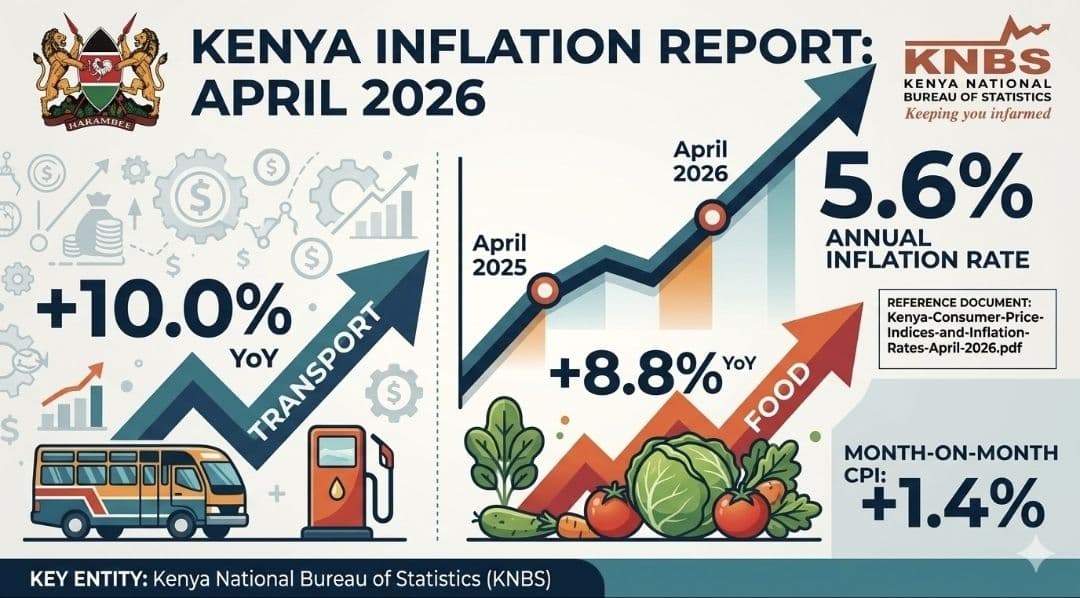
Inflation in Kenya Accelerates to 5.6 Percent as Transport and Food Costs Surge
May 3, 2026
Kenya’s headline inflation rate climbed to 5.6 per cent in April 2026, up from 4.4 per cent in March, as a sharp spike in transport costs and persistent food price pressures weighed on the economy. Data released by the Kenya National Bureau of Statistics (KNBS) indicates a significant month-on-month jump of 1.4 per cent, pushing the Consumer Price Index (CPI) from 150.00 to 152.15.
Fueling the Surge: The Transport Shock
The primary catalyst for the April acceleration was a dramatic 6.5 per cent monthly increase in the transport division. This surge was underpinned by a sharp rise in energy costs:
- Diesel prices jumped by 17.9 per cent in a single month.
- Petrol prices rose by 10.8 per cent.
These energy shocks cascaded through the logistics chain, forcing operators to hike fares. Boda boda (motorcycle) fares increased by 6.1 per cent, while country bus and matatu fares for inter-town travel rose by 9.7 per cent. On a year-on-year basis, the transport index has now swelled by 10.0 per cent.
The Breadbasket Burden
Food remains a central pain point for Kenyan households. The Food and Non-Alcoholic Beverages category, which carries the heaviest weight in the CPI basket (32.9%), rose by 8.8 per cent over the last 12 months.
While some seasonal relief was seen in the price of cabbages (down 3.3%) and oranges (down 1.9%), other staples continued to climb:
- Tomatoes saw a significant 9.0 per cent price surge in April alone.
- Irish potatoes and salad cooking oil increased by 2.8 per cent and 2.7 per cent, respectively.
- Beef with bones saw an annual price increase of 11.1 per cent.
Core vs. Non-Core: A Tale of Two Indices
The divergence between core and non-core inflation highlights the volatility currently hitting the Kenyan market.
- Core Inflation: Measuring non-volatile items like manufactured food, health, and education, core inflation stood at a relatively stable 2.8 per cent in April.
- Non-Core Inflation: Driven by volatile energy and fresh produce prices, this figure reached a staggering 13.4 per cent.
"Core inflation contributed 3.2 points, while non-core inflation contributed 2.4 points to the overall inflation in April 2026." — Macdonald G. Obudho, PhD, Director General, KNBS.
Understanding the CPI
For users of our inflation calculator, it is worth noting that the Consumer Price Index (CPI) measures the weighted aggregate change in retail prices for a fixed basket of goods and services. The current index uses February 2019 as its base period.
While electricity costs provided a rare bright spot—declining by 0.6 per cent in April—the surge in Gas/LPG prices (7.3% monthly) and fuel costs suggests that Kenyan consumers will continue to face a tightening squeeze on their disposable income in the coming months.
Given the sharp rise in non-core inflation, do you think the central bank should prioritize stabilizing fuel prices or focus on the broader core inflation trend?
Source: Anaylsis based on the official Kenya Price Indices and Inflation Rates for April 2026 release by the Kenya National Bureau of Statistics. The report can be found here https://www.knbs.or.ke/reports/consumer-price-indices-and-inflation-rates-april-2026/
How inflation Affects your Money
Curious how much your Kenyan Shilling has changed in value? See what 1 KES from 1963 could buy today using our inflation calculator or inflation adjustment calculator available at Yuthufu.com
Posted by: Yuthufu